.png&w=3840&q=75)
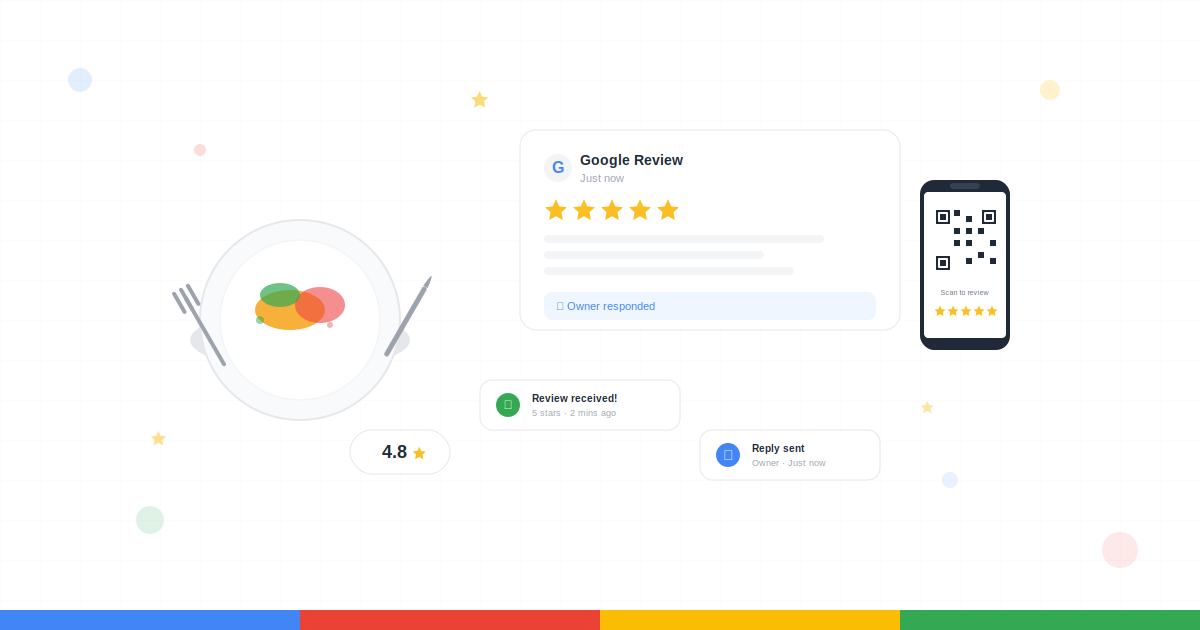
Your food might be exceptional. Your service might be warm, fast, and personal. But if your Google profile has 23 reviews and the place across the street has 310, most new diners won't give you the chance to prove it. Google reviews for restaurants carry more weight than almost any other industry — diners make fast, emotional decisions before they ever see your menu. This guide covers the practical side: how to collect more reviews, how to respond to the specific types of feedback restaurants actually get, and how to turn your review profile into a genuine competitive advantage.
What You'll Learn in This Guide:
- Why Google reviews hit harder for restaurants than most other businesses
- How to collect more reviews with staff scripts and frictionless tools
- Restaurant-specific response templates for every situation
- How to handle food complaints, wait-time issues, and fake reviews
- The mistakes that silently damage your restaurant's review profile
- Answers to the most common questions restaurant owners ask about reviews
90%
of diners read reviews before choosing a restaurant
4.0★
minimum rating a third of diners require before visiting
5–9%
revenue increase per additional star (Harvard Business School)
60s
average time a hungry diner spends choosing a restaurant online
Why Google Reviews Hit Harder for Restaurants
Every local business benefits from reviews. But restaurants sit in a uniquely high-stakes category. Here is why.
Diners decide fast
A shopper might spend days comparing products. A hungry person searching "Thai food near me" at 7pm will pick a restaurant within 60 seconds. Your star rating and review count are often the only things they look at before tapping "Directions."
Food is personal
Unlike a plumber or accountant, a restaurant experience is subjective and emotional. People review restaurants more often — and more passionately — than almost any other business type.
Reviews compound into ranking
Google's local search algorithm weighs review quantity, quality, and recency when deciding which restaurants appear in the Maps 3-Pack. Restaurants with a steady flow of recent reviews consistently outrank those with stale profiles, even if the older profile has a higher average rating. Our breakdown of Google reviews and SEO goes deeper on exactly how this works.
One star = real money
A widely cited Harvard Business School study found that each additional star on review platforms can increase restaurant revenue by 5–9%. For a restaurant doing £500,000 a year, even a half-star improvement could mean £25,000+ in additional revenue.
How to Collect More Google Reviews for Your Restaurant
Most happy diners leave without reviewing — not because they didn't enjoy the meal, but because nobody asked and the moment passed. Fixing that gap is the single highest-ROI action most restaurant owners can take.
Ask at the right moment
The best time to ask is during the meal, not after. When a guest says "this is amazing" or compliments a dish to the server, that's the window. Train your front-of-house staff to respond with a brief, genuine ask:
The key is catching the emotional high point. Once a guest walks out the door, the likelihood of a review drops sharply.
Make it frictionless
Every extra step between "I should leave a review" and actually posting one costs you completions. Remove as much friction as possible:
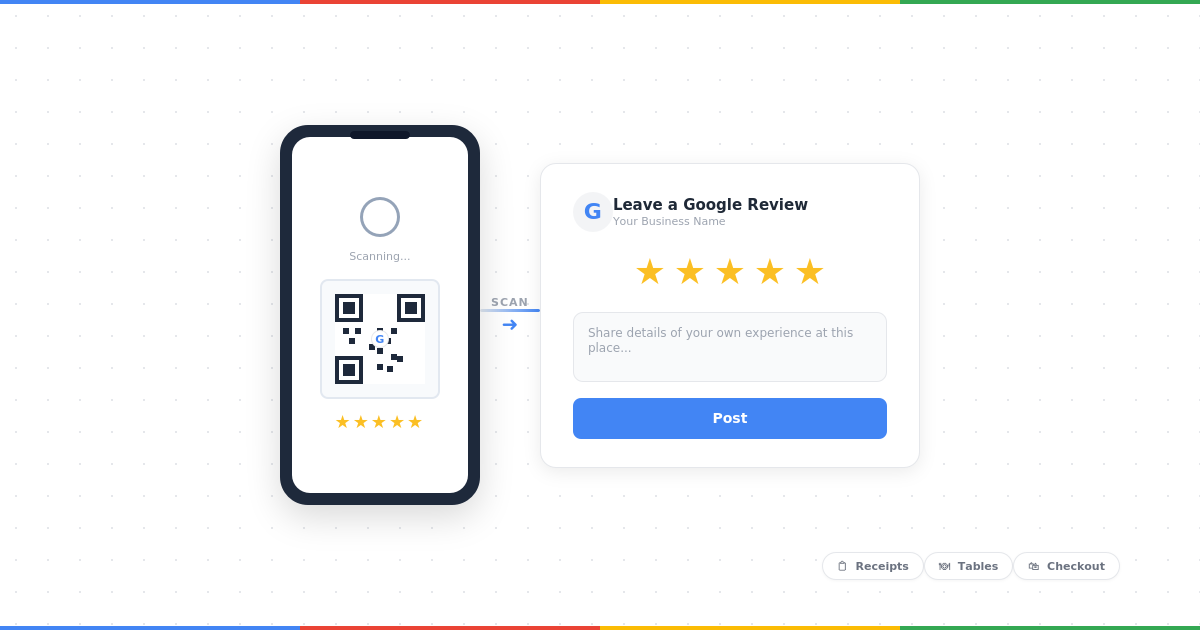
- QR codes on tables, receipts, and menus. A scannable code that opens the Google review box directly is the fastest path. Print it on table tents, at the bottom of receipts, or on a small card presented with the bill.
- A direct Google review link. Don't send people to your Google Business Profile homepage and hope they find the review button. Use a direct link that opens the review form immediately. You can create a Google review link for free in seconds.
- Follow up with online order customers. Dine-in guests get asked in person, but delivery and takeaway customers are often forgotten. Send a short SMS or email within 2 hours of delivery with your review link.
Use post-meal follow-ups
For reservations and online orders where you have the customer's contact details, a well-timed follow-up message works well. Keep it short and personal:
💡 Pro Tip
Tuesday to Thursday, late morning tends to get the best open rates for review request emails. Avoid Friday evenings and Monday mornings.
Restaurant-Specific Review Response Templates
Generic response templates don't work well for restaurants. A diner who complains about cold food needs a different reply than someone upset about a long wait. These templates are built for the situations restaurants actually face.
Positive Review — Praised the Food
— The [Restaurant Name] Team
Positive Review — Praised the Service or Staff
— [Your Name], [Restaurant Name]
Positive Review — Special Occasion
— [Restaurant Name]
Positive Review — Stars Only, No Text
— [Restaurant Name]
Negative Review — Food Quality Complaint
— [Your Name], [Restaurant Name]
Negative Review — Long Wait Time
— [Restaurant Name] Team
Negative Review — Service or Staff Complaint
— [Your Name], [Restaurant Name]
Negative Review — Wrong Order or Missing Items
— [Restaurant Name]
Negative Review — Pricing or Value Complaint
— [Restaurant Name] Team
Review from a Non-Customer
This is a common frustration — someone leaves a 1-star review after being turned away, or confuses your restaurant with another. Respond calmly:
— [Restaurant Name]
💡 Pro Tip
If a review is clearly fake or from someone who never visited, you can flag it for removal through your Google Business Profile. Google won't always act, but it's worth trying — especially if you have documentation. For a full walkthrough on disputing unfair reviews, see our guide on handling bad Google reviews.
Neutral 3-Star Review
— [Restaurant Name]
Common Restaurant Review Challenges (And What to Do)
"The food was awful" — but taste is subjective
This is one of the hardest reviews for restaurant owners to read. The rule: never argue about taste. Acknowledge their experience, express genuine concern, and invite them back. Fighting a subjective opinion publicly always makes you look worse.
Reviews about things outside your control
Parking, weather, nearby construction, a loud table of guests — some complaints have nothing to do with your food or service. Respond graciously, acknowledge the frustration without accepting blame for something you didn't cause, and redirect to what you can control.
Competitor or fake reviews
If you suspect a review is from a competitor or someone who never visited, flag it through Google Business Profile and use the non-customer template above. A measured, professional public response often builds more trust than the fake review destroys.
Delivery complaints when you use third-party apps
A cold meal that arrived late because of a delivery platform issue can still land as a 1-star review on your Google profile. Acknowledge the issue, clarify briefly that delivery was handled by a third party, and offer to make it right directly. Don't blame the platform aggressively — it comes across poorly.
Getting Your Staff on Board
Your front-of-house team interacts with every guest. They're your best review collection asset — but only if they're trained and comfortable asking.
Give them a script, not a speech
Keep it to one sentence: "If you enjoyed your meal, an honest Google review would really help us out — I can send you the link." No hard sell, no awkwardness.
Make it part of the routine
The ask should happen as naturally as offering dessert or dropping the bill. When it's woven into the service flow, it stops feeling like a favour and starts feeling normal.
Recognise the team for results
Some restaurants run friendly competitions between shifts — whoever drives the most reviews in a month gets a small bonus or recognition. It keeps the momentum going.
Mistakes That Hurt Restaurant Review Profiles
-
✗
Responding emotionally to negative reviews. A defensive reply to a food complaint can go viral for all the wrong reasons. Step away, cool down, then respond.
-
✗
Ignoring reviews entirely. When prospective diners see dozens of reviews with zero owner responses, it signals that management doesn't care.
-
✗
Copy-pasting the same response to every review. "Thank you for your kind words! We look forward to seeing you again!" repeated 30 times looks robotic. Personalise every reply — even briefly.
-
✗
Only asking for reviews after complaints. If the only time you engage with the review process is after something goes wrong, your profile will skew negative. Build review collection into positive moments.
-
✗
Offering incentives for reviews. "Leave a 5-star review and get a free dessert" violates Google's policies. It can get reviews removed and your entire listing penalised. Ask for honest reviews — never for positive ones specifically.
Frequently Asked Questions
How many Google reviews does a restaurant need?
There's no fixed number, but research suggests clear trust thresholds. Around 50 reviews, credibility starts forming. At 100+, you're signalling a strong, established business. More important than total count is velocity — restaurants generating 3–5 new reviews per week tend to outrank competitors with larger but stale review profiles.
How should a restaurant respond to a negative review about food?
Never argue about taste. Acknowledge their experience, express genuine concern, and invite them to contact you directly so you can understand what happened. A calm, empathetic response to a food complaint can actually build more trust with prospective diners than a page of 5-star reviews. For detailed templates, see our full guide on how to respond to Google reviews.
Can a restaurant get a fake Google review removed?
You can flag reviews that violate Google's policies — spam, fake content, off-topic posts, or reviews from people who never visited. Google doesn't always act, and they won't verify whether the content is factually true or false. Your best strategy is to flag it, respond professionally and publicly, and continue building genuine reviews that push it down.
Do Google reviews actually help restaurants rank higher?
Yes. Google's local search algorithm uses review quantity, quality, and recency as core ranking signals. Restaurants with consistent fresh reviews and high engagement (including owner responses) are significantly more likely to appear in the Maps 3-Pack — the top three local results that capture the majority of clicks and foot traffic.
Start Building Your Restaurant's Review Profile
Google reviews for restaurants aren't a marketing nice-to-have — they're the foundation of how new diners find you, trust you, and choose you over the competition. The restaurants that win on Google make review collection a daily habit, train their team to ask at the right moment, and respond to every review with genuine care.
Start with one step today. Print a QR code for your tables, train your servers on the one-sentence ask, or set up a post-meal follow-up for online orders. Every review you collect compounds into better rankings, more foot traffic, and more revenue over time. Need to understand the full picture of how reviews and local search connect? Our Google reviews and SEO guide explains the ranking signals in detail.